





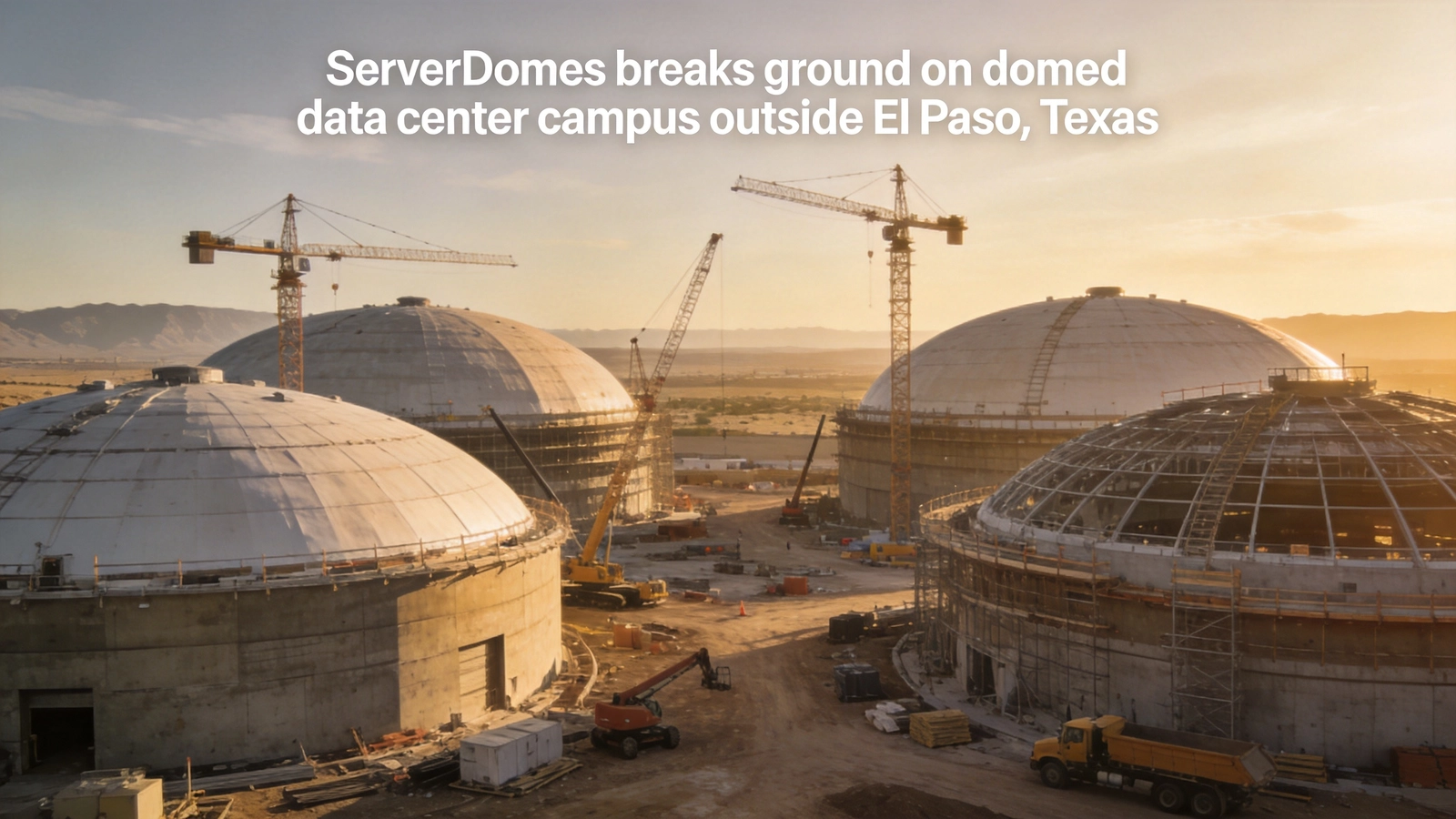
The 350MW project is expected to comprise ten buildings across roughly 700 acres of a 2,000-acre site that was previously idle ranch and oil and gas land. Power will be supplied through a behind-the-meter gas solution, with some reports indicating the site may also include geothermal generating capacity. The company's prefabricated dome shells, measuring 600 feet by 300 feet, can reportedly be delivered in as little as 12 months, with each dome capable of supporting approximately 20MW. The campus will employ a closed-loop cooling system to reduce water usage.
Construction on the $10 billion project has already commenced, and phase one reportedly has tenants secured. ServerDome Global is working alongside investment firm Kaufman & Company on the Texas development. The project first came to public attention earlier this month after Hudspeth County Judge Joanna E. MacKenzie published an open letter confirming that a developer was exploring construction in the area. David J. Keegan, CEO of ServerDome Global, subsequently apologized for the lack of advance notice given to local residents and officials.
The original ServerDomes concept was spun out of Oregon Health & Science University, which built a domed data center facility in Hillsboro, Oregon, in 2014. That facility featured a geodesic dome made of aluminum and relied on natural convection to cool servers without air conditioning units, exhaust fans, dehumidifiers, chillers, or CRACs. The company was formally spun out and launched its distinctive geodesic design in 2017. The dome structure incorporates air intakes near the bottom and vents toward the top, with an airfoil to improve exhaust and a vegetative bio-swale surrounding the facility for additional cooling and air supply. The company now says its design can support both air and liquid cooling, offering densities of up to 250kW per rack.
Beyond Texas, ServerDome Global lists planned projects in Port Mackenzie, Alaska; Prairie County, Montana; Mesa, Arizona; Mona, Utah; and Saudi Arabia. Keegan has previously said the company is also targeting a development outside Houston in Wharton, Texas. The company has reportedly broken ground on a project in Juab County, Utah, known as Granite Fortress, which will use rooftop solar for some of its power needs and will seemingly not employ the dome design. Kaufman has said it is working to bring domed data center campuses to Louisiana, Oklahoma, North Dakota, and South Dakota, as well as international markets including India, Europe, and Canada.
Daniel Kaufman, founder of Kaufman & Company, framed the design philosophy in broader terms, saying in a July announcement that "the issues of power, water, appearance, and jobs are real, impactful concerns, and we were seeing them in our own projects and across the industry." He added that "the geometry is what makes this exciting. It is a dome with a green roof that blends into the landscape rather than another lit box stretching for miles." The project's reliance on on-site gas generation rather than grid power reflects a growing industry trend toward self-supplied energy solutions, though it also raises questions about emissions and long-term energy costs as natural gas prices fluctuate. For Hudspeth County, the development promises significant capital investment and job creation, but the rushed rollout has already strained communication with local stakeholders—a dynamic that increasingly plays out across rural communities hosting new data center projects.